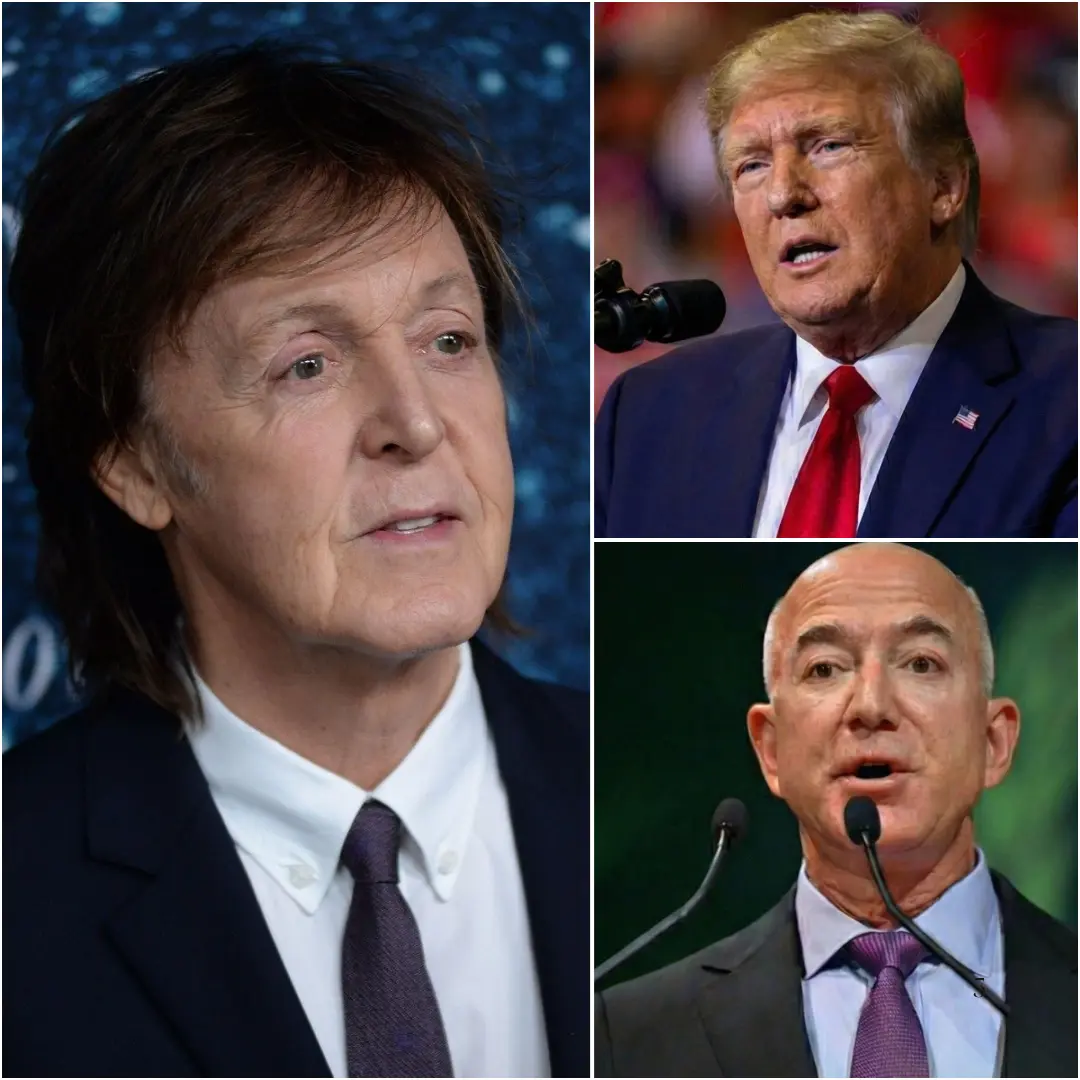
“Wake up, Jeff.”

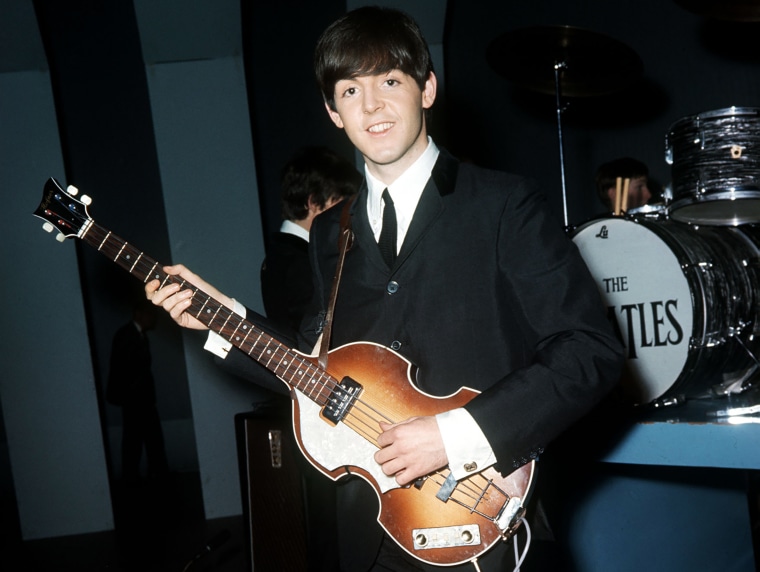
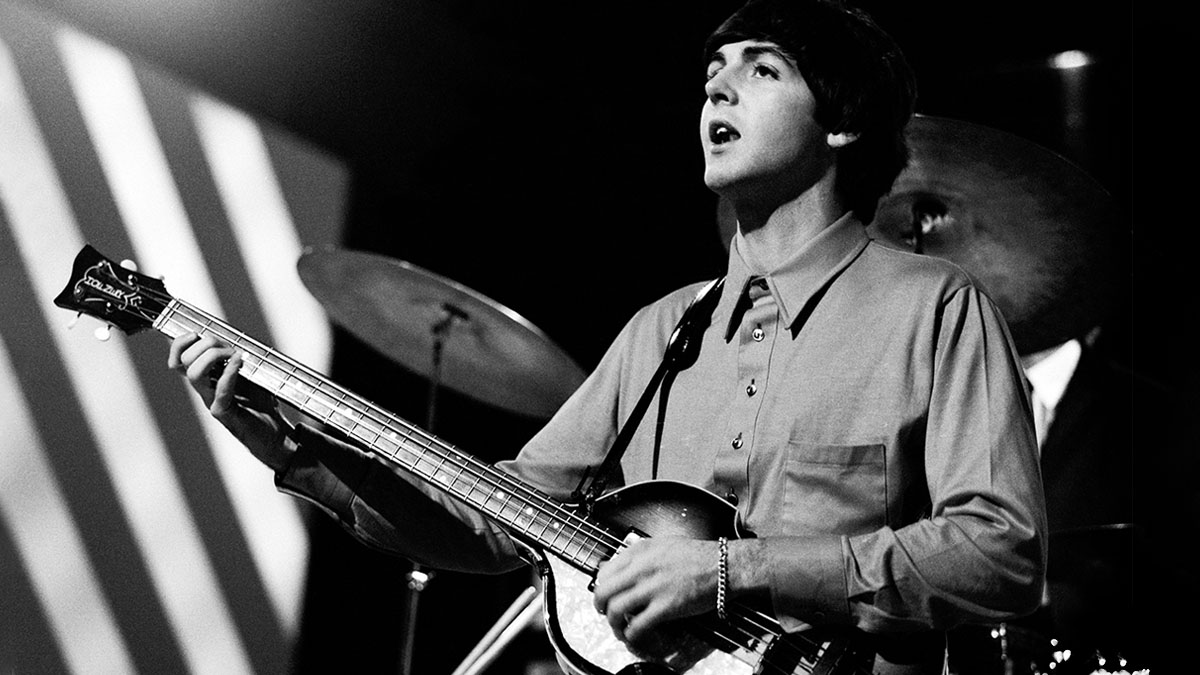
The words were direct. Unfiltered. Impossible to ignore.
In a move that sent shockwaves through both the music industry and the political world, Paul McCartney has reportedly announced he would pull his entire music catalog and official merchandise rights from Amazon, sharply criticizing Jeff Bezos over what he described as Bezos’ “perceived alignment” with Donald Trump.
The statement, released late last night, escalated quickly into a public ultimatum that stunned executives, fans, and political commentators alike.
“You support Trump, you support the division of real Americans,” McCartney declared in a rare and forceful message. “I cannot be a part of that.”
For an artist long known for messages of unity, peace, and reconciliation, the tone was strikingly firm. McCartney has spent decades advocating for humanitarian causes, environmental protection, and global cooperation. But this time, there was no metaphor, no poetic ambiguity — just a direct line drawn in the sand.
According to industry insiders, Amazon executives were caught off guard. While corporate disputes over streaming royalties are not uncommon, this was different. This was ideological. Personal. Public.
Sources close to the situation claim Bezos was “stunned” by the speed and intensity of the move. There was reportedly no extended negotiation period, no quiet back-channel discussions. Within hours of the statement circulating online, fans began speculating about whether McCartney’s music would disappear from streaming platforms and online retail shelves entirely.
The ripple effect was immediate. Social media platforms lit up with debate. Supporters praised McCartney’s willingness to take a stand, calling it “courageous” and “principled.” Critics accused him of politicizing art and alienating segments of his audience.
Then, the response came.
On Truth Social, Donald Trump fired back, labeling McCartney a “controversial performer,” an “aging entertainer,” and “desperate for headlines.” The comments quickly spread across news outlets and online forums, amplifying the standoff.
But the legendary Beatle did not retreat.
Hours later, McCartney delivered a reply that consisted of just eight words.
“History remembers who stood for love.”
The sentence was brief. Calm. Almost gentle.
And yet it landed with force.
Within minutes, hashtags referencing the statement began trending globally. Musicians, actors, and public figures weighed in. Some echoed his message. Others urged de-escalation. The internet, predictably, fractured into camps.
What makes this confrontation particularly notable is McCartney’s cultural stature. As a founding member of one of the most influential bands in history and a solo artist with a career spanning more than six decades, his voice carries generational weight. He is not simply another celebrity entering a political dispute; he is a symbol of an era that championed ideals of peace and unity during deeply turbulent times.
Observers point out that McCartney has rarely engaged in direct partisan combat. While he has expressed opinions on social and political issues before, he has generally avoided naming individuals in such pointed terms. That departure from his usual approach is part of what made this moment feel seismic.
Analysts also note the broader context: the increasingly blurred lines between business, entertainment, and politics. Corporations are scrutinized for perceived political affiliations. Artists are pressured to speak out — or stay silent. Consumers make purchasing decisions based not only on price and quality but on ideology.
In that landscape, McCartney’s declaration reads less like an isolated protest and more like a reflection of the times.
Still, questions remain.
Would pulling his catalog materially impact Amazon’s vast ecosystem? Financially, perhaps not in a significant way. Symbolically, however, the gesture resonates. It suggests that even legacy artists with nothing left to prove are willing to leverage their cultural capital for principle — or at least for what they believe to be principle.
Meanwhile, fans are left navigating the emotional crosscurrents. For many, McCartney’s music has been the soundtrack to weddings, graduations, road trips, and quiet personal moments. Seeing that legacy entangled in political confrontation is jarring.
Yet others argue that art has always been intertwined with politics. From protest songs of the 1960s to modern advocacy anthems, music has long served as a platform for social commentary. In that sense, McCartney’s stance may be less of a break from tradition and more of a continuation of it.
As of this morning, Amazon has not released a detailed public response. Representatives declined to comment on whether negotiations are underway or whether McCartney’s catalog will remain accessible through its services.
What is clear is that the episode has reignited a familiar debate: Should artists separate their work from politics? Or is silence itself a political act?
McCartney appears to have chosen his answer.
The eight words he offered did not attack, did not escalate in kind, did not mirror the tone of the criticism directed at him. Instead, they invoked legacy — something he understands intimately.
“History remembers who stood for love.”
Whether one agrees with his stance or not, the phrase reframed the confrontation in broader terms. It shifted the focus from personalities to values. From headlines to hindsight.
In an era dominated by rapid-fire outrage and viral soundbites, that subtle pivot may explain why the internet erupted not just with noise, but with something resembling reflection.
The situation remains fluid. Industry observers are watching to see whether other artists follow suit. Political commentators are analyzing the cultural implications. Fans are refreshing streaming apps, wondering what changes — if any — might come next.
But beyond the corporate logistics and partisan reactions, one thing is undeniable: Paul McCartney has once again demonstrated his ability to command global attention with a handful of carefully chosen words.
And this time, the stage wasn’t a stadium.
It was the world.

 wever, is that McGraw’s team emphasized progress.
 n redefine how they are seen.