The Silent Star Speaks: The Capitol Hill Outburst Attributed to Keanu Reeves
WASHINGTON, D.C. — The halls of the Rayburn House Office Building are no stranger to heated testimony and political grandstanding. However, a narrative currently racing across digital platforms describes a moment so jarring it reportedly brought C-SPAN’s cameras to a stuttering halt. The subject? Hollywood’s most reclusive "nice guy," Keanu Reeves.

According to the viral account, Reeves stood before a hushed committee and ignited a rhetorical wildfire with eleven simple words: “I’m tired of people who keep insulting America.”
The "Statement" Heard 'Round the Web
The narrative suggests that Reeves, known for his stoic roles in John Wick and The Matrix, abandoned his trademark neutrality to address what he perceived as a lack of gratitude among certain political figures. The account claims he specifically took aim at Representative Ilhan Omar (D-MN), accusing her of mocking the country that provided her refuge and success.
The purported statement, which has "detonated" across social media timelines, allegedly included the following scathing critique:
“Especially those who came here seeking safety, built a life under our freedoms, then turn around and mock the country that gave them a chance—while collecting a taxpayer-funded paycheck and flying abroad to lecture Americans like we’re the problem.”
A Departure from the "Keanu Code"

The reason this story has gained such immense traction—despite a total lack of primary source evidence—is the sheer contrast it provides to Reeves’ established public image. For decades, Reeves has followed a "code" of radical kindness and absolute privacy. He is the actor who gives up his seat on the subway and shares his millions with film crews, not the one who enters the partisan cage-match of Washington D.C.
If such an event had occurred, it would represent one of the most significant shifts in celebrity political engagement in modern history. The account describes a room filled with "gasps" and "shouts," with security stiffening as the actor allegedly delivered the ultimatum: “If you can’t respect this country, the door isn’t locked. Love it—or leave it.”
The Anatomy of a Modern Myth
As the "C-SPAN clips" mentioned in the story continue to be sought by thousands of users, fact-checkers and political analysts have noted the hallmarks of a "digital legend." The story utilizes several high-intensity emotional triggers:
The Reluctant Hero: Using a beloved, non-confrontational figure like Reeves makes the "outburst" feel more earned and "authentic."
The Patriotism Pivot: The narrative taps into deep-seated national debates regarding patriotism versus dissent.
The High-Stakes Setting: Placing the event on Capitol Hill lends it an air of institutional gravity.
Despite the vivid descriptions of "phones slipping from hands" and "commentators panicking," no major news outlet has verified the appearance. Representative Omar’s office has not released a rebuttal, and "The Squad" has remained quiet—likely because the confrontation never took place outside of the digital imagination.
The Real-World Impact of Fictional Firestorms
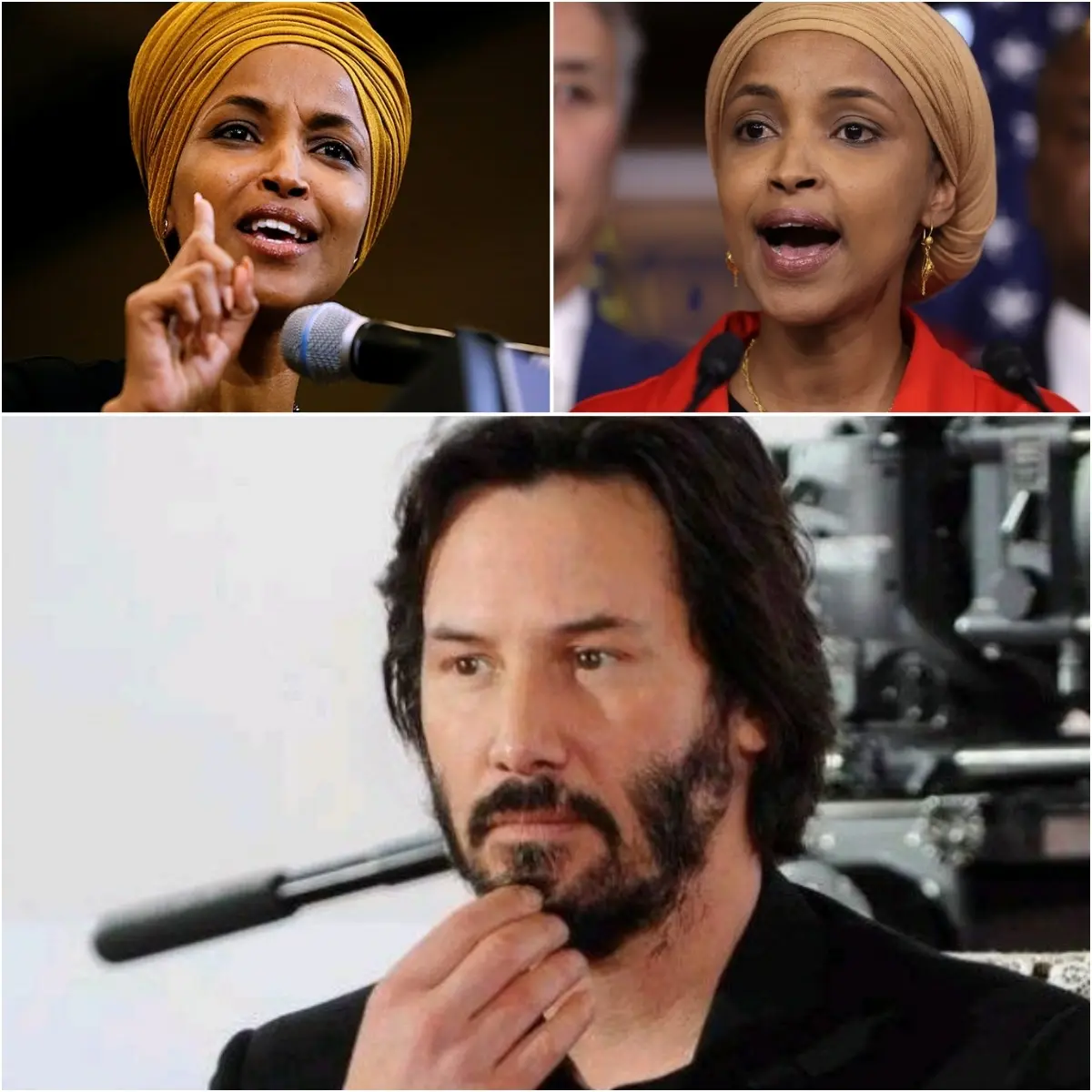
While the event is a fabrication, the reaction to it is very real. The story has become a mirror for the American electorate. For supporters, the fictionalized Reeves represents a "silent majority" finally finding a voice. For critics, the narrative is viewed as an inflammatory tactic designed to use a celebrity’s likeness to fuel division.
The image provided alongside this inquiry—featuring text about a "tough wife" and a "scared, pale" appearance—further complicates the digital footprint of this story, suggesting that various emotional narratives are being blended together in the "attention economy" of 2026.
Conclusion: The Man Behind the Myth
In reality, Keanu Reeves remains what he has always been: a man who prefers the quiet of a motorcycle ride to the roar of a political rally. His actual recent activities have focused on his literary collaborations and his continued work in cinema.
The "Capitol Hill Fire Alert" serves as a potent reminder of how quickly a well-crafted story can race from a screen to the national consciousness. In an era of deepfakes and rapid-fire misinformation, the "heavy silence" described in the story is perhaps most accurately found in the space where the evidence for this event should be.
Keanu Reeves didn't strike a match in a powder keg; instead, the internet built a powder keg around his likeness. As the smoke clears, the actor remains unmoved—not because he is "calm as ice" in a hearing room, but because he was never there to begin with.