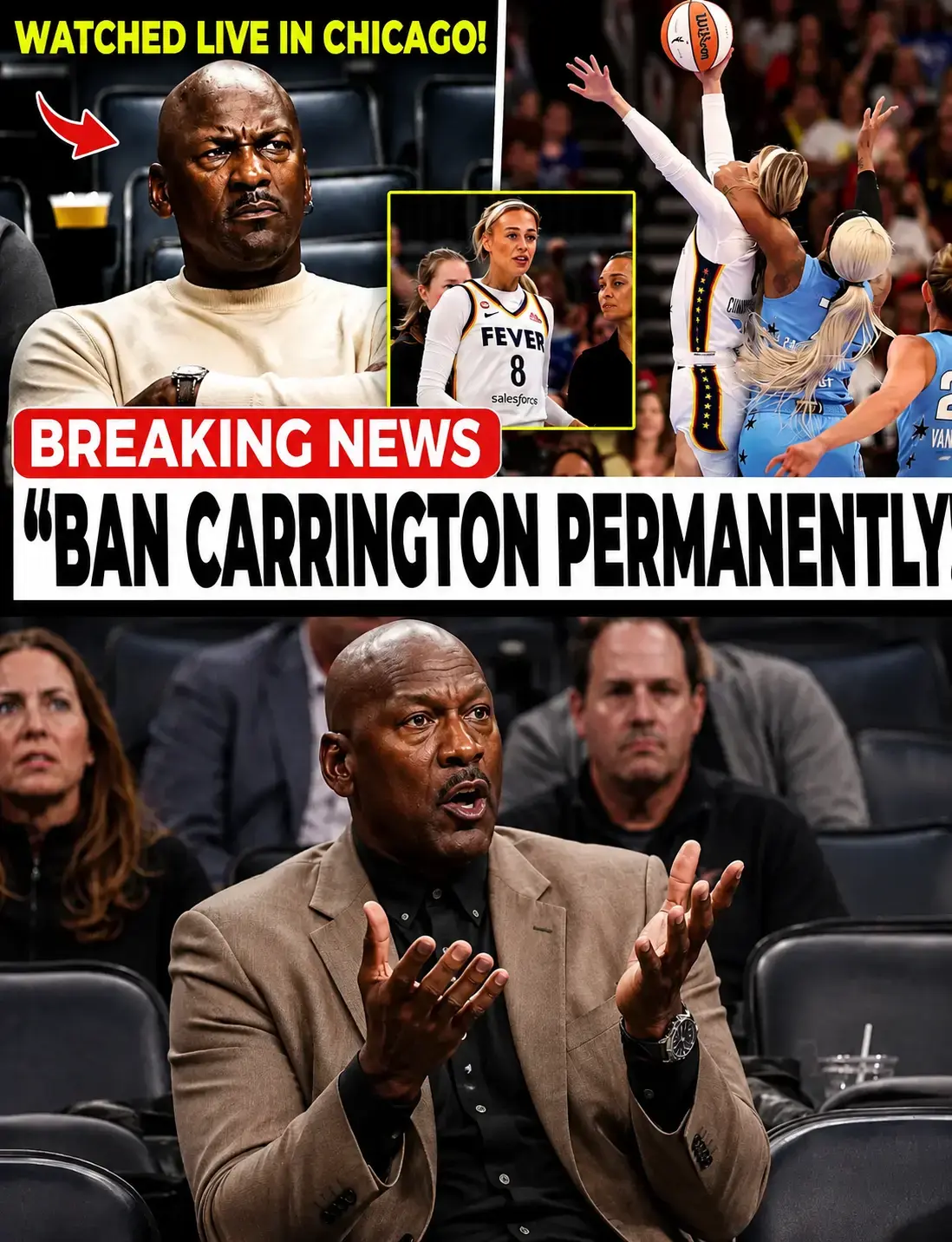
🚨🏀 MICHAEL JORDAN’S NAME IS BEING PULLED INTO THE EXPLOSIVE WNBA CONTROVERSY SURROUNDING DIJONAI CARRINGTON AND SOPHIE CUNNINGHAM — BUT ONE MAJOR PART OF THE VIRAL STORY REMAINS UNVERIFIED. The confrontation itself became a major talking point after Carrington’s hard foul on Cunningham was upgraded to a Flagrant 2, resulting in Carrington’s ejection. The controversy intensified after Carrington posted the words “WHITE PRIVILEGE,” while Cunningham strongly rejected the idea that race should define what happened on the court. But as the debate spread, another dramatic claim emerged: Michael Jordan had supposedly stepped in and delivered a devastating response to the WNBA. That portion of the story has not been reliably established, making it important to separate the documented controversy from the viral claims surrounding it.

One hard foul was enough to ignite one of the most heated basketball debates of the moment.
Sophie Cunningham was attacking the basket when DiJonai Carrington pursued the play from behind.
Carrington attempted to stop Cunningham from finishing at the rim, but significant contact occurred around Cunningham's upper body and head-and-neck area.
Cunningham crashed hard to the floor.
She quickly got back to her feet, and emotions immediately spilled over.
The two players confronted each other as teammates and others moved between them.
Officials reviewed the play.
After looking at the replay, Carrington's foul was upgraded to a Flagrant 2.
She was ejected.
At that moment, the incident could have remained a debate about basketball.
Was it reckless?
Was it intentional?
Was a Flagrant 2 appropriate?
Those questions alone would have generated plenty of discussion.
Instead, what happened afterward transformed the incident into something much larger.
Carrington posted the words:
“WHITE PRIVILEGE.”

That message immediately exploded across social media.
Because it appeared shortly after the ejection, many people assumed Carrington was accusing officials of punishing her because Cunningham is white.
But Carrington subsequently pushed back against that interpretation.
She indicated that the message wasn't specifically meant to say her Flagrant 2 ejection happened because of white privilege.
She also denied deliberately trying to strike Cunningham in a dangerous area.
According to Carrington's explanation, she was trying to prevent an easy basket and the resulting contact was unfortunate rather than intentional.
Cunningham viewed the situation differently.
She strongly objected to the foul and rejected bringing race into the controversy.
Cunningham also pointed toward her own history with discipline, arguing that she had previously received serious punishment for physical plays and accepted responsibility when she believed punishment was warranted.
That disagreement became the heart of the controversy.
Carrington said there was no deliberate attempt to hurt Cunningham.
Cunningham believed the contact crossed the line.
Those are two different interpretations of the same play.
And that distinction matters.
A replay can show where contact occurred.
Officials can determine whether that contact satisfies the standard for a Flagrant 2.

But proving what someone intended inside a fraction of a second is considerably more difficult.
That is why opinions about the play should not automatically be transformed into facts about Carrington's motives.
The officials did make one concrete determination.
The foul was serious enough for a Flagrant 2.
Carrington was removed from the game.
That punishment was real.
But social media wasn't finished.
Soon another name began appearing beside Cunningham and Carrington.
Michael Jordan.
Suddenly, viral posts and videos began claiming that the six-time NBA champion had “destroyed” the WNBA with a powerful statement about the controversy.
Some versions suggested Jordan had defended Cunningham.
Others connected his supposed intervention to Caitlin Clark.
Still others claimed Jordan demanded stronger league discipline.
There is one major problem:
A reliably authenticated Michael Jordan statement matching those dramatic claims has not been established.
That makes a crucial difference.
Michael Jordan is one of the most recognizable athletes in history.
His name instantly changes the scale of any basketball conversation.
Put “MICHAEL JORDAN DESTROYS WNBA” above a video and millions of basketball fans have an immediate reason to click.
But a viral headline isn't evidence that Jordan actually said something.
For that, there should be an identifiable interview, recording, official statement or other credible primary source.
Without one, Jordan's supposed intervention should remain classified as an unverified viral claim.
And the controversy doesn't need Jordan to remain significant.
There are already serious questions surrounding what actually happened.
How physical should WNBA basketball be allowed to become?
Where should officials draw the line between a hard defensive play and dangerous contact?
Should additional punishment follow a Flagrant 2?
Are comparable incidents being disciplined consistently?
Those are legitimate basketball questions.
Caitlin Clark's name has inevitably entered the broader discussion as well.
Clark's enormous profile means almost anything involving the Indiana Fever receives additional scrutiny.
Her teammates' confrontations become national conversations.
Hard fouls become replayed repeatedly.
Technical fouls become headline material.
Every controversial officiating decision can generate thousands of competing interpretations within minutes.
But Clark should not automatically become the centerpiece of every incident involving another Indiana player.
The Carrington-Cunningham confrontation was fundamentally between Carrington and Cunningham.
Cunningham took the contact.
Carrington committed the foul.
Officials reviewed it.
Carrington was ejected.
Anything beyond those basic facts requires additional evidence.
The racial dimension makes accuracy even more important.
Carrington's use of the phrase “white privilege” understandably generated strong reactions.
Some fans interpreted the post as an accusation about Cunningham.
Others interpreted it as criticism of broader treatment within professional basketball.
Carrington later attempted to clarify her meaning.
People are free to disagree with that explanation.
But they should disagree with what she actually said rather than a more dramatic version created afterward.
The same standard applies to Cunningham.
Her criticism of Carrington can be discussed without adding words she never spoke.
And it applies equally to Jordan.
His legendary status should not be used to manufacture authority for an argument he hasn't publicly made.
There is already enough genuine tension here.
A player was knocked down.
Another player was ejected.
The two disagreed over intent.
A social-media message brought race into the discussion.
Fans divided into opposing camps.
And questions about officiating and discipline spread throughout the basketball community.
None of that requires an invented quote.
The incident also highlights something increasingly important about modern professional sports.
Games no longer end when players leave the court.
A controversial play can become a national argument before the postgame press conference even begins.
Someone posts a replay.
Another account adds dramatic music.
A caption assigns motives.
Another account attaches a celebrity's name.
Then an alleged quote appears.
Within hours, the fictionalized version can become more widely shared than the original event.
That is exactly why separating verified events from viral additions matters.
Carrington's Flagrant 2?
Real.
Her ejection?
Real.
The confrontation with Cunningham?
Real.
The “WHITE PRIVILEGE” post?
Real.
Carrington later disputing interpretations of that message and denying intentional dangerous contact?
Part of the documented public discussion.
The supposed blockbuster Michael Jordan intervention?
That requires much stronger evidence.
And until such evidence appears, it should not be presented as fact.
There is another important point.
Calling Carrington's play a “brutal attack” automatically assigns malicious intent.
The contact was serious enough to result in a Flagrant 2, and viewers can criticize the play forcefully.
But Carrington denied deliberately attempting to hurt Cunningham.
That denial doesn't determine what everyone must believe about the play.
It simply means intentional assault should not be stated as an established fact without evidence supporting that conclusion.
The WNBA can still be scrutinized.
Fans can question whether punishment is consistent.
Analysts can compare similar plays.
Players can demand better protection.
And Cunningham can strongly criticize what happened to her.
Those conversations are part of professional sports.
But they become stronger when based on what actually happened.
Michael Jordan does not need to “destroy” the WNBA for the league to face legitimate questions.
Caitlin Clark doesn't need to be inserted into every confrontation for player safety to matter.
And Carrington doesn't need to be assigned motives beyond what the evidence establishes for people to debate whether her foul crossed the line.
What happened on the court was controversial enough.
What happened afterward made it even bigger.
Now the challenge is separating the basketball incident from everything the internet has added to it.
Because in an era when one dramatic headline can reach millions of people within hours, accountability isn't only something expected from players and leagues.
It also matters when telling the story.
DISCLAIMER: This article distinguishes the documented Carrington–Cunningham controversy from additional viral claims surrounding it. Carrington's Flagrant 2 and ejection, her subsequent “WHITE PRIVILEGE” message, and the public dispute over the incident form the basis of the controversy. Carrington denied intentionally trying to injure Cunningham and later clarified the interpretation of her social-media message. The claim that Michael Jordan personally “destroyed” the WNBA or issued a dramatic statement defending Sophie Cunningham or Caitlin Clark should be treated as unverified unless an authentic statement, recording or other reliable primary evidence establishes otherwise.