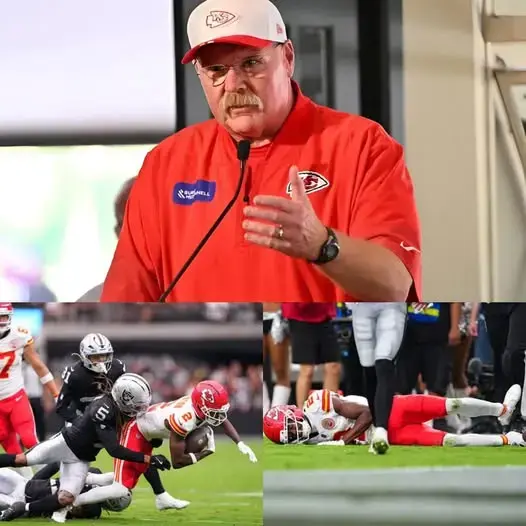
🚨🏈 “THAT WASN’T FOOTBALL — THAT WAS CHAOS” — A Fiery Statement Attributed to Andy Reid After Chiefs’ 30–27 Win Over Raiders Is Exploding Online, but the Alleged Cheap-Shot Controversy Raises One Huge Question 🔥😳
Kansas City walked out of Las Vegas with the result it wanted.
Chiefs 30.
Raiders 27.
Another victory in one of the NFL’s most bitter divisional rivalries.
But according to a dramatic statement circulating after the game, the scoreboard supposedly told only part of the story.
The lengthy message attributed to Chiefs head coach Andy Reid describes something far darker than an ordinary AFC West battle. It alleges intentional contact after the whistle, taunting around an injured player and behavior serious enough to trigger questions about player safety and sportsmanship.
There is an important distinction, however.
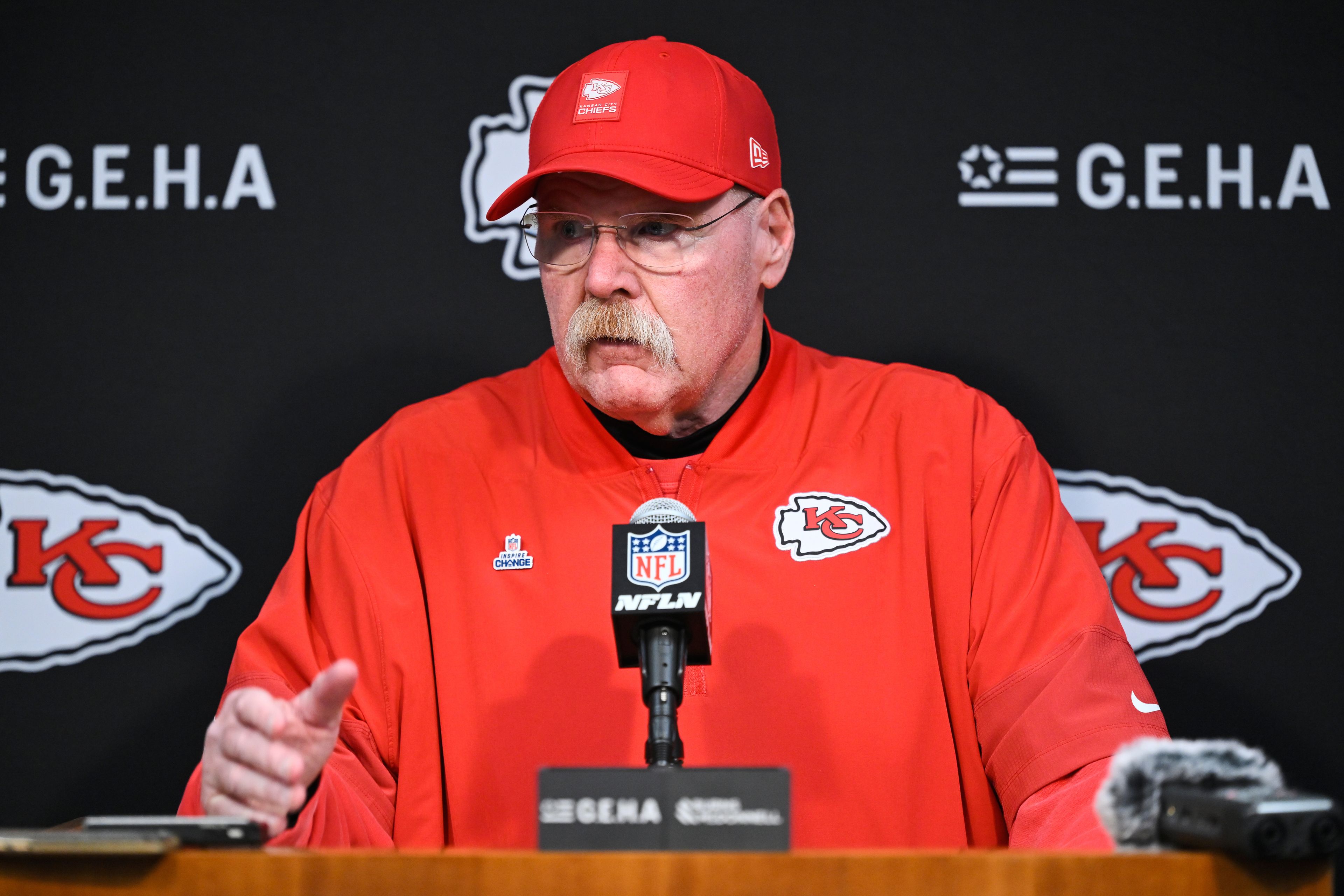
While Kansas City’s 30–27 victory over Las Vegas is documented, the lengthy statement presented above should not be treated as an authenticated Andy Reid press-conference transcript without a verifiable recording or official source establishing that Reid actually delivered those words.
Nor should an unnamed Raiders player be accused of intentionally injuring somebody based solely on a viral account.
Still, the scenario raises a legitimate football question.
Where does aggressive rivalry football end — and unacceptable conduct begin?
Chiefs-Raiders has never required artificial intensity.
The rivalry has decades of it already.
These teams share a division, history and plenty of mutual frustration. Every meeting carries something beyond the standings.
Players know it.
Coaches know it.
Fans certainly know it.
Physicality is expected.
But football has always contained an important distinction between hitting someone hard during a legal play and deliberately targeting someone outside the boundaries of competition.
That distinction is at the heart of the viral statement.
“When a player goes after the ball, you can see it,” the attributed message says. “But when a player goes after another man after the whistle, that’s not a football move; that’s a choice.”
It is a powerful line.
But without independent authentication, it should be read as part of the circulating account rather than presented as Reid’s confirmed words.
The principle behind it, however, is difficult to dispute.
The whistle matters.
Football allows extraordinary physical contact because that contact occurs within defined rules.
A defender can deliver a violent legal tackle.
An offensive lineman can move a defender with enormous force.
Players can collide at remarkable speed.
But once a play is over, the competitive justification for that contact changes.
That is why late hits, unnecessary roughness and unsportsmanlike conduct can carry significant consequences.
The Chiefs’ actual victory already contained enough drama without adding an unverified postgame scandal.
Kansas City entered the fourth quarter trailing 13–10.
Then the game exploded.
Patrick Mahomes connected with Tyquan Thornton for a touchdown.
Kenneth Walker III became the defining offensive force of the afternoon, finishing with 177 rushing yards and scoring twice in the fourth quarter.
Kansas City eventually built a 30–19 advantage.
Las Vegas refused to disappear.
Kirk Cousins found Brock Bowers for a late touchdown, and the Raiders converted the ensuing two-point attempt.
Suddenly it was 30–27.
One possession separated the teams.
Las Vegas got the football again with an opportunity to produce a stunning finish.
But the final push ended with an interception.
Mahomes kneeled.
Game over.
Kansas City had survived.
What made the result particularly frustrating for Las Vegas was that the Raiders had produced plenty of offense.
Cousins threw for 365 yards.
Las Vegas accumulated more total yardage than Kansas City and controlled possession for long stretches.
But turnovers and crucial late-game execution favored the Chiefs.
That is the documented football story.
The alleged post-whistle controversy requires a higher evidentiary standard.
Calling a hit “intentional” is not simply criticizing technique.
It assigns motive.
Calling something a “cheap shot” similarly implies that a player knowingly violated the boundaries of legitimate competition.
Those claims should be supported by clear footage, officiating reports or disciplinary findings before they are attached to a specific athlete.
That does not mean player-safety concerns should be minimized.
Quite the opposite.
The NFL has spent years attempting to reduce dangerous contact, particularly blows involving the head and neck, defenseless players and unnecessary actions after plays have ended.
Enforcement is imperfect.
Officials make judgment calls in real time while 22 athletes move at extraordinary speed.
Some fouls are obvious.
Others look completely different when slowed down from multiple camera angles.
And some incidents that appear outrageous from one angle turn out to be more complicated on review.
That is why postgame video review exists.
The league can evaluate plays after the stadium empties.
It can examine angles officials did not have.
It can determine whether additional discipline is warranted.
That process is more reliable than deciding intent from an angry social-media clip.
But the larger emotional point contained in the circulating statement is understandable.
Coaches are responsible for more than winning.
They are responsible for players whose careers depend on their bodies remaining functional.
Every collision has consequences.
Players accept significant physical risk when they enter an NFL game.
What they should not have to accept is unnecessary risk created after the competitive portion of a play has ended.
That is where sportsmanship becomes more than a ceremonial handshake.
It becomes a safety mechanism.
Rivalries intensify emotion.
Emotion can improve performance.
A player may tackle harder, run harder and fight for every inch because the opponent across from him represents something personal.
But discipline determines whether that emotion remains useful.
Lose discipline and the rivalry changes.
Penalties arrive.
Ejections become possible.
Players retaliate.
Someone gets injured.
A football game can become something neither coaching staff actually wants.
One passage in the viral statement emphasizes Kansas City players supposedly refusing to retaliate.
Again, without authentication, that specific claim should not be placed directly in Reid’s mouth.
But restraint is one of the most valuable traits a championship-level team can develop.
Retaliation is frequently punished.
A player who responds to provocation can become the one officials see.
Fifteen yards can change a possession.
An ejection can change a game.
A suspension can affect the following week.
Veteran teams understand that discipline is not weakness.
Sometimes walking away is the more competitive decision.
Kansas City’s sustained success under Reid has required exactly that kind of situational awareness.
Mahomes’ spectacular throws receive attention.
Travis Kelce’s catches receive attention.
Explosive touchdowns receive attention.
But championships are also won through less glamorous decisions.
Protect the football.
Understand down and distance.
Avoid unnecessary penalties.
Do not allow emotion to erase strategy.
The Chiefs needed all of that against Las Vegas.
This was not an easy victory.
Kansas City trailed.
The Raiders challenged them physically.
Las Vegas created one final opportunity to steal the game.
And Kansas City still found a way out.
That should be enough to make the rematch compelling.
If league review ultimately identifies a play deserving further scrutiny, then the evidence should determine what happens next.
If no such finding emerges, an inflammatory viral statement should not become a substitute for one.
That distinction matters especially in an era when dramatic quotes can travel across social media faster than the underlying video.
Within minutes, an unattributed paragraph can become a “press conference.”
An invented sentence can become a “breaking quote.”
And suddenly thousands of people are debating something a coach may never have said.
Chiefs-Raiders does not need manufactured hatred.
The rivalry already has enough history.
Kansas City’s 30–27 victory already had enough tension.
And player safety is important enough that it should be discussed with evidence rather than exaggeration.
Football is violent by design.
It is also governed by boundaries.
The best players understand both.
They can hit hard without abandoning control.
They can despise losing without losing discipline.
They can play an opponent with extraordinary intensity and still recognize that the man across from them has a career, family and future beyond the next snap.
That is ultimately the strongest message contained in this viral story — regardless of whether Reid actually delivered the speech attributed to him.
Rivalry should make football more intense.
It should never make basic respect optional.
“Let me be clear — I’ve coached this game for a long time, and I thought I’d seen it all. But what happened out there tonight? That wasn’t football — that was chaos disguised as competition.”
I’ve been in this business long enough to know the difference between a hard-nosed rivalry battle and crossing the line. We got the 30–27 victory against the Las Vegas Raiders tonight, but I cannot simply walk into that locker room, smile, and pretend everything was fine.
What unfolded on that field went far beyond X’s and O’s, far beyond standard AFC West physical football. It was about something deeper — about respect, player safety, and the line between playing hard and flat-out unsportsmanlike conduct.
When a player goes after the ball, you can see it — the discipline, the purpose, the fight. But when a player goes after another man after the whistle, that’s not a football move; that’s a choice.
That hit? Intentional. No question about it. Don’t try to tell me otherwise, because everyone watching saw what came after — the taunts, the smirks, the mockery over a hurt player. That wasn’t emotion; that was ego. And if that’s what we’re calling “rivalry fire” or “tough defense” now, then something has gone terribly wrong in this sport.
Look, I’m not here to call out names or create unnecessary drama — we all know exactly who and what I’m referring to. But to the NFL and the officiating crew who worked this game, hear me clearly: this wasn’t just a missed personal foul. It was a missed opportunity to uphold the very principles this league claims to stand on — player safety and basic sportsmanship.
You talk about protecting players, you talk about player welfare, and you hold meetings about integrity. Yet tonight, we watched cheap shots brushed aside as if they’re just another snap. It’s not. It’s not football when player safety becomes secondary and when fundamental respect gets lost in the noise.
If this is the direction professional football is heading, if this is what we’re willing to tolerate just because two division rivals don't like each other, then even in victory, we’ve lost a piece of what makes this sport great.
Yes, the Kansas City Chiefs earned the 30–27 win on the scoreboard. But what matters most to me is that my players didn’t lose their composure, their discipline, or their integrity. They took the hits, they kept their heads, they played clean, and they refused to stoop to that level or let frustration turn this into a street fight. For that, I couldn’t be prouder of our guys.
Still, this win leaves a bitter taste — not because of the result, but because of what was allowed to happen between the lines. And until the league draws a hard, undeniable boundary between relentless competition and reckless hostility, it’s the players — the young men who pour their health, bodies, and careers into this game — who will keep paying the price.
I’m not saying this because of the heat of the moment. I’m saying it because I love this game — and I’m not willing to stand here quietly and watch it lose its soul.
Full details👇